- Aug 24
Yann LeCun: Artificial Intelligence Models Are Flawed
- Larry Maguire
- Artificial Intelligence
- 0 comments
Yann LeCun is a significant figure in the world of Artificial Intelligence research, and when he says large language models are a dead end, it gets attention. Former Chief AI Scientist at Meta, LeCun shared the 2018 Turing Award with Geoffrey Hinton and Yoshua Bengio for the work that made deep learning possible. His Convolutional Networks from the late 1980s remain the foundation of classification and computer vision technology today. He is not without controversy, and upon leaving Meta in 2025 he announced that the entire commercial direction of Artificial Intelligence is a dead end. With backers, he formed a new venture, AMI Labs operates with locations in Paris, New York, Montreal and Singapore. The operational thesis being that "Real intelligence does not start in language. It starts in the world."
LeCun's Five Objections to Large Language Models
LeCun thinks the industry in which he built his work has taken a wrong turn and although his reasons for believing so may be technological, it is also true philosophically. As I have argued before, inanimate material cannot develop human-level intelligence, self-awareness, or consciousness because inanimate material is what consciousness looks like on the surface. Some suggest the case for Super Intelligence is not the same as consciousness. However, I would argue they are the the same thing. Roger Penrose, for example, said that in order for something to display intelligent behaviour, there must be consciousness. In the counter approach to the current Large Language Model of AI, LeCun states five specific objections some of which you may be familiar yourself in your everyday use of AI.
One: No Model of the Physical World
According to the Sapir-Whorf hypothesis, language both describes the world and shapes our model of it. Language has developed as a means by which we explain our experience and communicate, however it doesn't capture the entirety of human experience. In many ways, in fact, language fails to capture what we feel and what we mean so how is it possible that language models can know the world? Arguably we know it, but we have not the language to explain or describe it. We can train a model on language and text, but it merely learns the description if, indeed, it is even true to state this. it holds no persistent internal state to check a claim against.
LeCun's own comparison is a four-year-old, who has processed more raw sensory data through vision alone than the largest language models have seen in text. The child additionally has an internal experiential state, something that no LLM has. Children learn about their world experientially and in the early months and years, without language. The ability to use language comes later. Unlike so-called intelligent machines, the human organism interacts with the environment and it learns. Robotics have no capacity for this, or at the very least it is extremely limited, LeCun says, by the absence of the proliferation of self driving vehicles in novel environments. Bottom line, there is no ghost in this AI machine and the ghost may be the essential missing component.
Two: Large Language Models Do Not Reason
According to LeCun, what looks like reasoning in a model's chain of thought is merely a longer output generation and not reasoning itself. Text goes in as words and comes out as words, but nothing in between can be considered words. A separate component, the tokeniser, breaks the input into fragments and assigns each one a number that indexes against a lookup table. The model consumes those numbers and what it emits is not a word or even a choice. Choice implies volition, and the model has none. It is a score for every fragment in its lookup table and a downstream sampler picks one according to those scores. That fragment is appended to the input and the whole operation runs again from the start.
LeCun draws the comparison to Kahneman & Tversky's System 1 and 2 model of mind. Answering with a fixed amount of computation per token is, in his words, "very much akin to the human fast and subconscious 'System 1' decision making". The automatic mode Kahneman described is one that drives a car without thinking about it. There is no IQ operational here. What we call reasoning is System 2 and is deliberate and effortful. It works by spending more time, deliberation and consideration on the outcome weighing up choices and possibilities. Current models have no way to deliberate and consider. It cannot slow down at the difficult step, so producing a chain of thought is, as he puts it, a matter of tricking the model into producing more tokens. You will notice if you have ever received a response that was confident but wholly inaccurate.
Three: LeCun Says Hallucination Is Structural
Let's first address the question of hallucination. Borrowed from human experience, hallucination implies there is a conscious entity which can or does, in fact, hallucinate. That is to say, see and experience a world that nobody else in their immediate proximity experiences. Hallucination is to create a reality for oneself beyond that of every other human being. Machines don't hallucinate, they produce output based on statistical probability. Whatever it is, it is not hallucination and it is not obfuscation either, another term sometimes used to describe the inaccuracy yet confidence of a models output.
So let's assume we agree on that and lend AI researchers the term, albeit inaccurately used. LeCun's argument is that fine-tuning reinforcement learning from human feedback and more training data reduce the rate of "hallucination" by the model without addressing the cause. A system with no grounded model of what's true has nothing against which to check its output. Where a gap exists it fills it with whatever is statistically plausible - that's all. Mitigations work, and retrieval and verification layers work well enough for many production uses, but they compensate for the architecture and leave the cause in place.
Four: Large Language Models Cannot Plan
Planning means holding a goal, imagining outcomes, considering the implications of our pursuit on other stakeholders and selecting actions that move towards it. A teenager learns to drive in twenty hours or so, mostly by building a rough physical intuition for how a car behaves. It is learning that occurs below the level of conscious effort. Autonomous driving has consumed enormous investment, and while Waymo and others now run driverless commercial services, conveniently, they do this inside mapped and geofenced territory with remote support. Nobody has produced a system that handles novel conditions the way a competent human driver does after a fortnight of practice.
When you see a murmuration of starlings in the autumn over a lake in the countryside, you see them move effortlessly and in unity. They never crash into one another. They display the majesty of collective mind in action. There is no one director, they act as one, yet when they land they become individuals again poking around at the grass for food. They display complexity in flight, that aspect of being that simply does and cannot be explained through mathematics and statistical analysis. The point here is that artificial intelligence technologies works best in deterministic environments. Novel environments cause problems that human beings and animals can quite easily navigate successfully. Machines can't do this, at least not yet.
Five: Scaling Large Language Models Will Not Close the Gap
Returns are diminishing, says LeCun, and each new order of magnitude of compute buys less improvement than the last. At a CES fireside chat in January 2025, LeCun said "scaling is saturating". Continuing to push it is expensive enough that OpenAI and many others are still not making money from it. Others look at the same curves and see an artefact of how we measure, or point to reinforcement learning on verifiable tasks as something that still has legs. What nobody disputes is the scale of the money riding on the answer, which points to an AI bubble the bursting of which brings the entire house down.
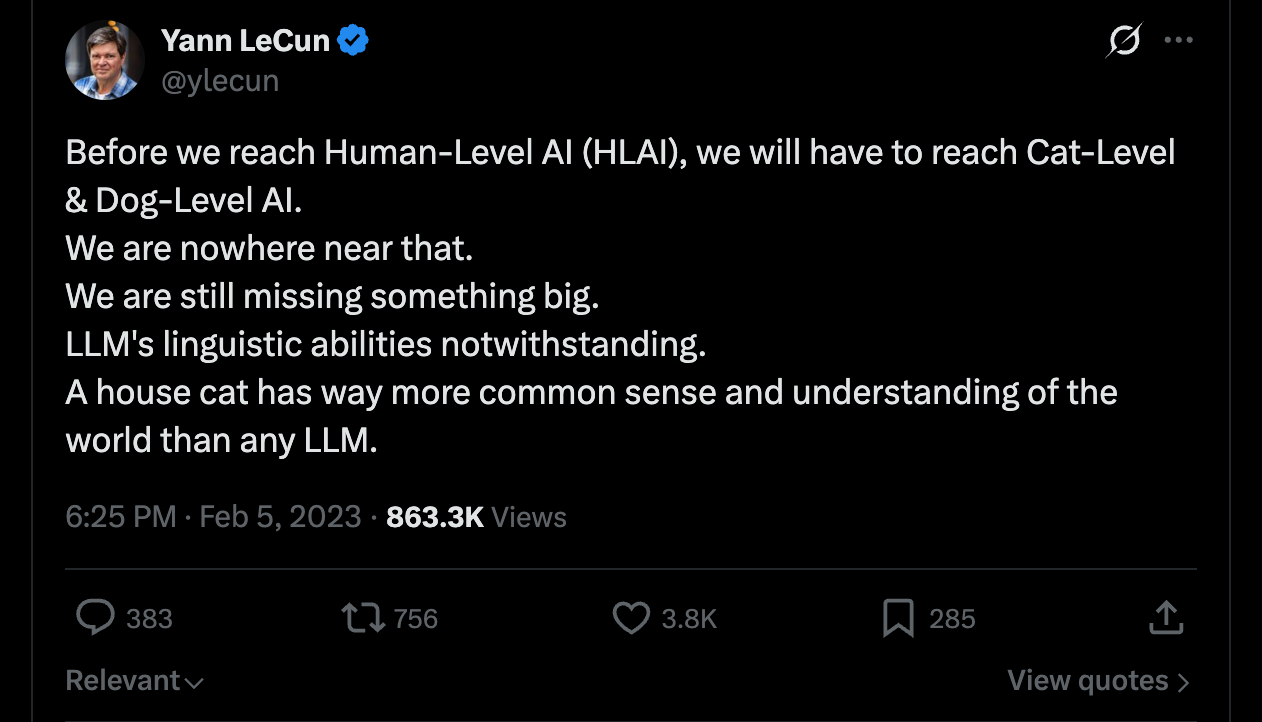
LeCun wrote on X in February 2023 that before anything reaches human-level intelligence, it will have to reach cat-level and dog-level intelligence, and we are nowhere near it yet. A house cat, he said, has considerably more common sense and understanding of the world than any large language model. I don't believe we are anywhere near the singularity, as Sam Altman has recently claimed. In fact, it seems that LeCun's views might be based more upon reality than Altman's fanciful statements. After all, Altman is depending upon a successful IPO. I wouldn't remove the chance that someday this might be achieved, and in a Financial Times interview in May 2024, different architecture will certainly be required.
What JEPA Proposes Instead
LeCun's alternative to the current model is JEPA, the Joint Embedding Predictive Architecture. It predicts the representation of missing parts of its input in an abstract latent space, discarding unpredictable detail where a token-by-token model would try to reconstruct everything in full. The claim is that this forces the system to learn the structure of what it observes beneath the surface.
The most direct test of that claim so far is VL-JEPA, submitted in December 2025 while LeCun was still at Meta. It replaces token generation with embedding prediction in a vision-language model. In a controlled comparison against standard training, on the same encoder and the same data, it performed better with half the trainable parameters.
The researchers say that at 1.6B parameters it matches much larger conventional models on visual question answering. On video classification and retrieval it outperforms the three encoders the field measures against. Those are OpenAI's CLIP (Contrastive Language-Image Pre-training), Google's SigLIP 2 (Sigmoid Loss for Language-Image Pre-training), and Meta's own Perception Encoder. Each of these learns to match images to the words that describe them, which is the task VL-JEPA is doing differently by working in an abstract representation space. It also decodes to text only when text is needed, cutting decoding operations by 2.85 times.
VL-JEPA shows the training objective is sound and efficient in a vision-language setting, and it says nothing about planning or a working world model. Those are the parts of LeCun's thesis that would apparently take longest to prove. He has said the project could take a decade to mature so we have some waiting to do yet before we know if he's on the right track.
Conclusion
Somehow human beings possessed the ability to foresee the consequences of our actions. We also have the ability to create a story for ourselves so as to avoid responsibility for these consequences, but that aside for a moment. You can tell in advance if you drop a potato into a hot pot of boiling water that it's likely to create a splash that can scald you. You know that it's going to hurt, so you take a different approach. You don't need dozens or perhaps hundreds of training runs to figure that out. LeCun sees the time when robotics will be able to anticipate these consequences too, but for now and with the models we have he says that's impossible.
LeCun's Advanced Machine Intelligence Labs (AMI) backed by $1 bn investment is getting close. That said, AI machines have no concept of the world like we do, and no concept of anything at all, in fact. They are statistical predictive machines, and their capacity to solve the world's problems is limited by that. A system with no wholistic concept of the world cannot be relied upon to answer the big questions, or more importantly, do what's right for people. Notwithstanding the established fact that these systems inherit the bias of their training data.
They are blind mechanisms, like a lever when turned presses widgets from steel, albeit more complex. The machine has no knowledge of what it makes, no knowledge of itself, and no knowledge of its own parts. The machine has no self-reflection, no experience, no grasp of consequence, and no ethics beyond what has been coded into it. Its bias is not a fault in the build, it is a property of the machine. My particular metaphysics does not allow me to see a time when inanimate matter develops consciousness or human level in intelligence no matter how sophisticated the electronic circuitry. Consciousness first, intelligent behaviour as a consequence. Everything else is mimicry.
Sources
Primary
AMI Labs, company statement of mission and approach. https://amilabs.xyz/
Bolya, D., Huang, P.-Y., Sun, P., et al. (2025). Perception Encoder, the best visual embeddings are not at the output of the network. arXiv:2504.13181. https://arxiv.org/abs/2504.13181
Radford, A., Kim, J. W., Hallacy, C., Ramesh, A., Goh, G., Agarwal, S., Sastry, G., Askell, A., Mishkin, P., Clark, J., Krueger, G., and Sutskever, I. (2021). Learning transferable visual models from natural language supervision. arXiv:2103.00020. https://arxiv.org/abs/2103.00020
Tschannen, M., Gritsenko, A., Wang, X., et al. (2025). SigLIP 2, multilingual vision-language encoders with improved semantic understanding, localization, and dense features. arXiv:2502.14786. https://arxiv.org/abs/2502.14786
VL-JEPA: Joint Embedding Predictive Architecture for Vision-language. Chen, D., Shukor, M., Moutakanni, T., Chung, W., Yu, J., Kasarla, T., Bang, Y., Bolourchi, A., LeCun, Y., and Fung, P. (2025). arXiv:2512.10942. https://arxiv.org/abs/2512.10942
Press reporting
LeCun, Y. (2023, 21 November). Post on X, fixed computation per token and the System 1 comparison. https://x.com/ylecun/status/1728867136049709208
LeCun, Y. (2024, 21 February). Post on X, on chain-of-thought prompting and Turing-completeness. https://x.com/ylecun/status/1760293812486725696
LeCun, Y. (2023, 6 February). Post on X, cat-level and dog-level intelligence. https://x.com/ylecun/status/1622300311573651458
LeCun, Y. (2024, 22 May). Post on X, autoregressive models insufficient for human-level intelligence, citing his Financial Times interview. https://x.com/ylecun/status/1793680385403957295
PYMNTS (2025, January). Report of LeCun's CES fireside chat, Las Vegas, 8 January 2025, where he said scaling is saturating. https://www.pymnts.com/artificial-intelligence-2/2025/meta-large-language-models-will-not-get-to-human-level-intelligence/
CNBC, 19 November 2025, on the departure from Meta. https://www.cnbc.com/2025/11/19/meta-chief-ai-scientist-yann-lecun-is-leaving-the-company-.html
MIT Technology Review, 22 January 2026, on the venture as a bet against large language models. https://www.technologyreview.com/2026/01/22/1131661/yann-lecuns-new-venture-ami-labs/
Crunchbase News, on the seed round. https://news.crunchbase.com/venture/world-model-ai-lab-ami-raises-europes-largest-seed-round/